
Dehumidifier for Electronics Manufacturing Industry

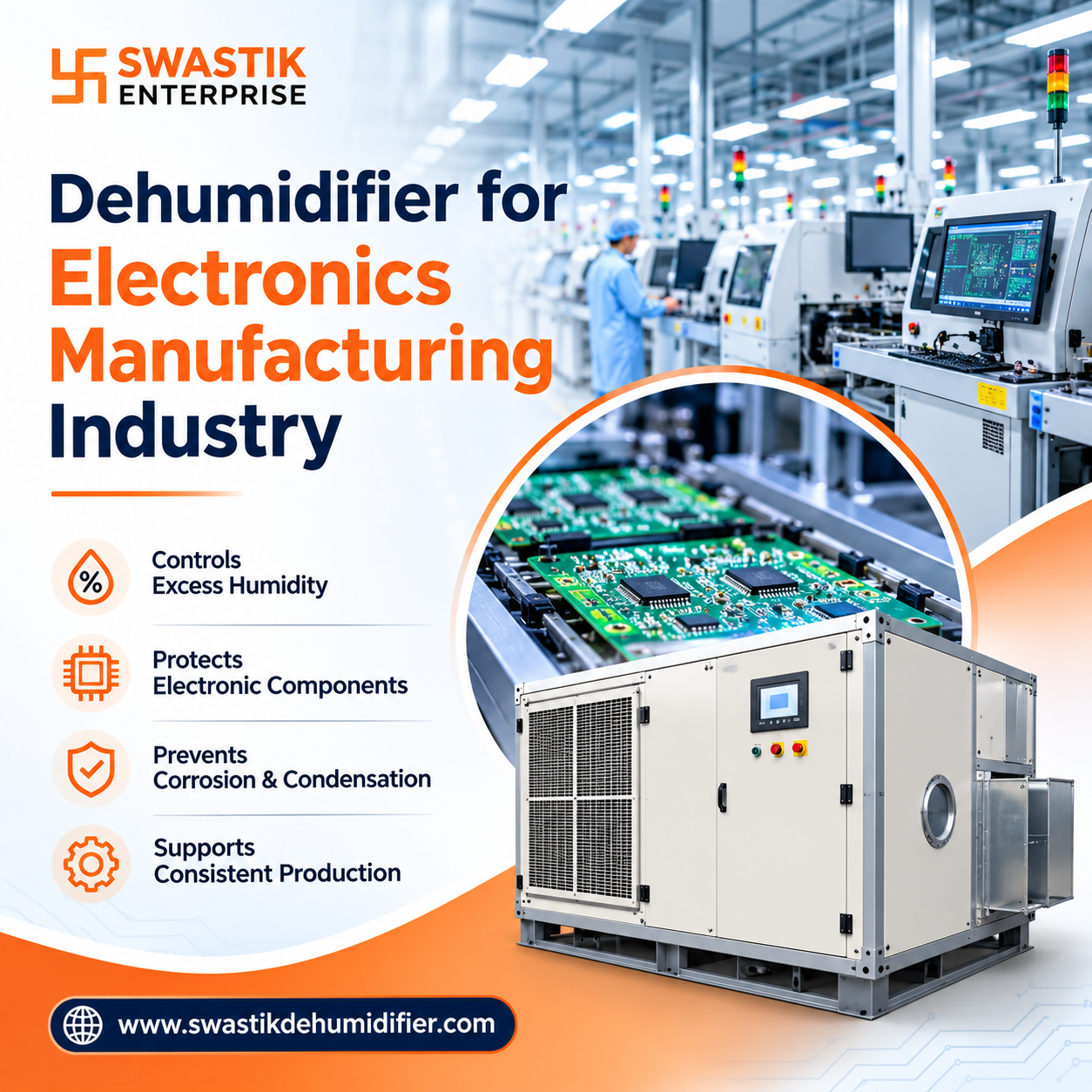
Industrial Dehumidifier for Electronics
Humidity control plays an important role in maintaining product quality, protecting sensitive components and ensuring reliable manufacturing processes in the electronics industry. From printed circuit board (PCB) production and surface-mount technology (SMT) assembly to semiconductor manufacturing and electronic component storage, excess moisture can create several operational challenges.
A dehumidifier for electronics manufacturing industry applications helps control excess moisture in production areas, assembly rooms, laboratories and storage facilities. Maintaining suitable humidity conditions can reduce condensation risks, limit corrosion and support a more stable manufacturing environment.
Electronic components, circuit boards and semiconductor devices may be sensitive to moisture exposure. When moisture enters certain electronic components, it can create problems during high-temperature soldering processes. High humidity can also affect metallic surfaces, equipment and stored materials if environmental conditions are not properly managed.
For electronics manufacturers, investing in an appropriate industrial dehumidification system is therefore an important part of environmental control. Selecting the right equipment depends on the manufacturing process, room conditions, moisture load and required humidity level.
In this article, we explore why humidity control is important in electronics manufacturing, how industrial dehumidifiers work, their applications in PCB and semiconductor production, and how to choose the right dehumidification solution for your facility.
Why Is Humidity Control Important in the Electronics Manufacturing Industry?
Electronics manufacturing involves several processes that require controlled environmental conditions. Components, circuit boards, connectors and other electronic materials can be affected by excessive moisture in the surrounding environment.
High relative humidity can contribute to condensation, corrosion and moisture absorption in certain materials. These problems may affect component reliability, production quality and equipment performance.
An industrial dehumidifier helps maintain controlled humidity conditions by removing excess moisture from the air.
Impact of High Humidity on Electronic Components
Many electronic components contain materials that can absorb moisture from the surrounding atmosphere. This is particularly important for components with moisture-sensitive packaging.
When moisture-sensitive components are exposed to high humidity for extended periods, they may absorb water vapour. During subsequent high-temperature soldering processes, the absorbed moisture can expand rapidly and create internal mechanical stress.
Potential problems include:
- Cracking in moisture-sensitive component packages.
- Delamination between internal material layers.
- Corrosion of exposed metallic surfaces.
- Deterioration of certain electrical connections.
- Reduced component reliability.
- Increased risk of manufacturing defects.
The IPC/JEDEC J-STD-033 standard provides guidelines for handling, packing, shipping and using moisture-sensitive devices to reduce moisture-related failures during manufacturing.
Maintaining suitable environmental humidity is one part of an overall moisture-control strategy for electronics manufacturers.
Moisture-Related Problems in PCB Manufacturing
Printed circuit board manufacturing and assembly involve several processes where moisture management is important.
PCB materials and certain electronic components can absorb moisture from the surrounding environment. During solder reflow, rapid heating may cause absorbed moisture to expand, potentially resulting in cracking, delamination and other defects in moisture-sensitive components.
Some common moisture-related challenges in PCB manufacturing include:
- Moisture absorption in PCB materials and component packages.
- Delamination and cracking during solder reflow.
- Corrosion of metallic surfaces and connectors.
- Condensation on equipment and stored materials.
- Inconsistent environmental conditions during production.
Installing an appropriate industrial dehumidifier can help control room humidity and support more stable manufacturing conditions.
However, room dehumidification should be combined with suitable component handling procedures, moisture barrier packaging and dry-storage practices where required.
Effects of Excess Moisture on Semiconductor Manufacturing
Semiconductor manufacturing involves sensitive materials, precision equipment and controlled production environments.
Although humidity requirements differ between semiconductor processes, uncontrolled moisture can create environmental challenges in areas where condensation, corrosion or moisture-sensitive materials are a concern.
Excess humidity may contribute to:
- Corrosion of metallic equipment surfaces.
- Moisture-related contamination concerns.
- Condensation on temperature-sensitive surfaces.
- Unstable storage conditions for sensitive materials.
- Additional environmental control requirements.
An industrial dehumidification system can help manage moisture levels in designated manufacturing and storage areas.
For facilities with specialised cleanroom requirements, the dehumidifier should be integrated with the overall HVAC and environmental control system.
Importance of Maintaining Stable Manufacturing Conditions
Consistent environmental conditions help electronics manufacturers maintain process stability and protect sensitive production materials.
Humidity fluctuations can affect different manufacturing areas in different ways. For example, an electronic component storage room may have different moisture-control requirements from a PCB assembly line or inspection laboratory.
A suitable humidity management system helps manufacturers:
- Maintain more consistent environmental conditions.
- Reduce condensation risks.
- Protect moisture-sensitive materials.
- Support equipment and material preservation.
- Improve control over manufacturing environments.
The required humidity range should be determined according to the production process, component specifications and applicable industry standards.
How Does a Dehumidifier Help in Electronics Manufacturing?
An industrial dehumidifier removes excess water vapour from the surrounding air and helps maintain the required relative humidity within a designated area.
The system draws moisture-laden air through its internal components, removes a portion of the water vapour and circulates drier air back into the room.
Depending on the technology used, industrial dehumidifiers generally operate through refrigeration or desiccant-based moisture removal.
Removal of Excess Moisture from Manufacturing Areas
Industrial dehumidifiers are designed to manage moisture in production rooms, warehouses, laboratories and other industrial environments.
A fan draws humid air into the equipment, where moisture is removed through a refrigeration-based or desiccant-based process.
The treated air is then returned to the manufacturing area.
This continuous air circulation helps maintain more stable humidity conditions and reduces excessive moisture accumulation in the room.
For electronics manufacturers, the required equipment capacity depends on room dimensions, ventilation, air leakage, internal moisture generation and operating conditions.
Maintaining Controlled Relative Humidity Levels
Relative humidity (RH) indicates the amount of water vapour present in the air compared with the maximum amount the air can hold at a particular temperature.
In electronics manufacturing, RH monitoring helps operators understand environmental conditions and identify humidity fluctuations.
Industrial dehumidifiers equipped with digital humidity controllers can help maintain a selected RH setpoint.
Important monitoring considerations include:
- Continuous relative humidity measurement.
- Suitable sensor placement.
- Digital humidity display.
- Automatic system operation based on setpoints.
- Monitoring of different production zones.
A properly designed humidity control system can help manufacturers maintain more consistent environmental conditions across designated areas.
Reducing Condensation and Moisture-Related Risks
Condensation occurs when a surface temperature falls below the dew point of the surrounding air.
In electronics manufacturing facilities, condensation can become a concern when humid air comes into contact with cooler equipment, metallic surfaces or stored materials.
An industrial dehumidifier lowers the moisture content of the air, which can reduce dew point and help minimise condensation risks when properly designed and operated.
This is particularly relevant in areas containing sensitive electronic equipment, electrical panels, connectors and metallic components.
However, equipment surface temperatures and local environmental conditions should also be considered during system design.
Supporting Electronic Component Storage Conditions
Electronic components often require specific storage and handling conditions based on their moisture sensitivity classification.
Excess moisture can be absorbed by certain component packages, making appropriate storage practices important.
Industrial dehumidifiers can help maintain suitable humidity conditions in designated storage rooms and warehouses.
Additional moisture protection methods may include:
- Moisture barrier bags.
- Desiccant packets.
- Humidity indicator cards.
- Dry cabinets.
- Component-specific storage procedures.
Combining room humidity management with appropriate storage practices helps manufacturers manage moisture exposure more effectively.
Applications of Dehumidifiers in the Electronics Manufacturing Industry
Industrial dehumidifiers have several applications across electronics production, component storage and quality-control environments.
Different manufacturing areas have different humidity requirements, making application-specific equipment selection important.
Dehumidifier for PCB Manufacturing
Printed circuit board manufacturing involves materials and processes that require controlled environmental conditions.
PCB fabrication and assembly areas may experience moisture-related challenges due to ambient humidity, material storage and temperature variations.
An industrial dehumidifier can help maintain suitable room humidity in:
- PCB fabrication areas.
- Circuit board assembly rooms.
- Component handling sections.
- PCB inspection and testing areas.
- Electronic material storage rooms.
Humidity control helps reduce excessive moisture exposure and supports consistent production conditions.
Manufacturers should also follow appropriate PCB material handling and moisture-sensitive component procedures to reduce the risk of defects during soldering.
Dehumidifier for SMT Assembly Lines
Surface-mount technology (SMT) is widely used in modern electronics manufacturing to mount electronic components directly onto printed circuit boards.
SMT assembly involves handling moisture-sensitive devices, solder paste, circuit boards and other materials that may require controlled storage and processing conditions.
High humidity can affect certain materials and contribute to moisture absorption in electronic component packages.
A suitable industrial dehumidifier can help control humidity in designated SMT production areas.
Potential applications include:
- SMT assembly rooms.
- Electronic component handling areas.
- Soldering and reflow production zones.
- Component storage sections.
- Inspection and quality-control areas.
For SMT facilities, humidity control should be coordinated with ESD protection, component moisture-sensitivity requirements and solder paste manufacturer’s storage specifications.
Dehumidifier for Semiconductor Manufacturing
Semiconductor production requires specialised environmental management because it involves sensitive materials, precision equipment and controlled manufacturing processes.
Industrial dehumidifiers can be used in selected semiconductor manufacturing and supporting areas where moisture control is required.
Applications may include:
- Semiconductor material storage.
- Supporting production rooms.
- Equipment and utility areas.
- Component handling environments.
- Designated controlled-humidity spaces.
In semiconductor facilities, the dehumidification system should be selected according to the process requirements and integrated with the facility’s HVAC and cleanroom design.
Dehumidifier for Electronic Component Storage
Electronic component warehouses and storage rooms often contain integrated circuits, sensors, connectors, semiconductor devices and other moisture-sensitive materials.
Prolonged exposure to unsuitable humidity conditions can increase moisture absorption in certain components.
An industrial dehumidifier helps maintain controlled humidity conditions in designated storage environments.
Key applications include:
- Electronic component warehouses.
- PCB material storage rooms.
- Integrated circuit storage areas.
- Electrical component warehouses.
- Sensitive electronic equipment storage facilities.
For moisture-sensitive devices, room humidity control should be supported by dry cabinets, moisture barrier packaging and handling procedures according to the component manufacturer’s specifications and applicable standards.
Dehumidifier for Electrical and Electronic Equipment Manufacturing
Manufacturers of electrical panels, control systems, electronic assemblies and industrial electrical equipment also require suitable moisture management.
Excess moisture may contribute to corrosion, condensation and deterioration of certain electrical components.
An industrial dehumidifier can help control moisture in:
- Electrical panel manufacturing areas.
- Control equipment assembly rooms.
- Electronic enclosure production facilities.
- Testing and inspection areas.
- Electrical component storage rooms.
Maintaining appropriate humidity conditions helps protect materials and supports a more controlled production environment.
Dehumidifier for Electronics Testing and Quality Control Laboratories
Electronics testing and quality-control laboratories often require stable environmental conditions to support consistent inspection and testing procedures.
Temperature and humidity fluctuations may influence certain materials, instruments and measurement processes.
Industrial dehumidifiers can be used in designated laboratory environments to manage excess moisture.
Applications include:
- Electronic component testing laboratories.
- PCB inspection areas.
- Product reliability testing rooms.
- Electrical equipment testing facilities.
- Research and development laboratories.
The humidity requirements should be determined according to the testing procedures, equipment specifications and relevant quality standards.
Which Type of Dehumidifier Is Suitable for Electronics Manufacturing?
Selecting the right industrial dehumidifier depends on the required humidity level, temperature conditions, moisture load and size of the manufacturing area.
Two commonly used industrial dehumidification technologies are refrigerant-based and desiccant-based systems.
Refrigerant Dehumidifier for Electronics Manufacturing
A refrigerant dehumidifier removes moisture by cooling humid air below its dew point.
The moisture condenses on the cooling coils and is collected or drained from the equipment. The treated air is then reheated and circulated back into the room.
The main operating stages include:
- A fan draws humid air into the unit.
- The air passes over cold evaporator coils.
- Water vapour condenses on the coils.
- Condensed moisture is collected and drained.
- The treated air is circulated back into the area.
Refrigerant dehumidifiers are generally suitable for applications where room temperature and humidity conditions allow effective condensation-based moisture removal.
Potential applications include general electronics manufacturing areas, equipment rooms and storage facilities.
Desiccant Dehumidifier for Electronics Manufacturing
A desiccant dehumidifier removes moisture through adsorption.
It uses a moisture-absorbing material, commonly silica gel, to capture water vapour from incoming air.
The main operating stages include:
- Humid air enters the dehumidifier.
- Air passes through a rotating desiccant wheel.
- The desiccant material absorbs moisture.
- Drier process air is supplied to the designated area.
- A separate reactivation air stream heats the desiccant to remove accumulated moisture.
- Moisture-laden reactivation air is discharged through an exhaust system.
Desiccant dehumidifiers are particularly useful for applications requiring lower humidity levels or operation under conditions where refrigeration-based systems may become less effective.
They can be considered for:
- Electronics component storage rooms.
- Moisture-sensitive material storage.
- Selected PCB manufacturing environments.
- Specialised assembly areas.
- Semiconductor support facilities.
Learn more about desiccant dehumidifier equipment from Swastik Enterprise.
Industrial Dehumidifier for Large Electronics Manufacturing Facilities
Large electronics manufacturing facilities may require dedicated industrial dehumidification systems to manage moisture across multiple production areas.
These systems can be selected according to the room size, ventilation rate, moisture load and required environmental conditions.
Important considerations include:
- Airflow capacity.
- Moisture extraction capacity.
- Required relative humidity.
- Operating temperature.
- Air distribution.
- Control and monitoring requirements.
- Energy consumption.
A properly designed industrial dehumidification system helps maintain suitable environmental conditions across the designated production areas.
Explore industrial dehumidifier solutions from Swastik Enterprise for different industrial humidity-control requirements.
Ideal Humidity Control Considerations for Electronics Manufacturing
There is no single relative humidity level suitable for every electronics manufacturing process.
Different materials, components and production activities have different environmental requirements. Therefore, manufacturers should establish humidity targets according to process specifications and applicable technical guidelines.
Understanding Relative Humidity in Electronics Manufacturing
Relative humidity is an important parameter in environmental monitoring.
It indicates how much water vapour is present in the air compared with the maximum amount possible at the same temperature.
For electronics manufacturers, RH monitoring can help identify conditions that may contribute to moisture absorption, condensation or other environmental issues.
A digital humidity controller and appropriately positioned sensors can help monitor conditions and regulate dehumidifier operation.
Humidity Requirements for PCB and SMT Assembly Areas
PCB and SMT manufacturing environments may require different humidity conditions depending on the materials, components and processes involved.
Moisture-sensitive electronic devices must be handled according to their moisture sensitivity level (MSL) and the applicable IPC/JEDEC handling procedures.
Manufacturers should consider:
- Component manufacturer’s recommended storage conditions.
- Moisture sensitivity classifications.
- Soldering and reflow temperatures.
- PCB material specifications.
- Solder paste storage requirements.
- Production room temperature and humidity.
Following these specifications helps reduce moisture-related production risks.
Humidity Control for Moisture-Sensitive Electronic Components
Some electronic components absorb moisture through their packaging materials when exposed to ambient conditions.
For these devices, manufacturers should implement suitable storage and handling procedures.
Depending on component specifications, these may include:
- Dry storage cabinets.
- Moisture barrier packaging.
- Desiccant materials.
- Humidity indicator cards.
- Controlled component exposure times.
- Approved baking procedures when required.
An industrial dehumidifier can help manage the surrounding room environment, but it does not replace the component-specific protection measures required under IPC/JEDEC standards.
Balancing Humidity Control and Electrostatic Discharge (ESD) Protection
Electrostatic discharge is an important consideration in electronics manufacturing because sensitive electronic components can be damaged by uncontrolled electrical charges.
Humidity can influence the accumulation and dissipation of static electricity. However, excessively dry conditions may increase electrostatic risks in some environments.
Therefore, manufacturers should not reduce humidity without considering their ESD control programme.
Important considerations include:
- Following the facility’s ESD control procedures.
- Using appropriate ESD flooring and work surfaces.
- Ensuring proper grounding.
- Monitoring environmental humidity.
- Using suitable ESD protective equipment.
- Maintaining process-specific humidity limits.
Humidity control and ESD protection should work together as part of an overall manufacturing environment management strategy.
Key Features to Consider When Choosing an Industrial Dehumidifier for Electronics Manufacturing
Choosing the right dehumidifier involves more than comparing product prices or moisture extraction capacity.
Manufacturers should evaluate the equipment’s technical specifications and suitability for the intended application.
Moisture Extraction Capacity
Moisture extraction capacity indicates how much water a dehumidifier can remove from the air over a specific period.
The required capacity depends on several factors:
- Total room volume.
- Initial and target humidity levels.
- Outdoor air infiltration.
- Door opening frequency.
- Number of people working in the area.
- Moisture generated by manufacturing processes.
- Ventilation and HVAC conditions.
A professional capacity assessment helps identify the appropriate equipment for the application.
Digital Humidity Controller and RH Monitoring
Accurate humidity monitoring is important for maintaining consistent environmental conditions.
An industrial dehumidifier with a digital humidity controller allows operators to monitor relative humidity and manage equipment operation according to the selected setpoint.
Useful features include:
- Digital RH display.
- Adjustable humidity settings.
- Automatic humidity-based operation.
- Reliable humidity sensors.
- External sensor placement where required.
Swastik Enterprise’s industrial dehumidifier range includes digital humidity control features for industrial applications.
Airflow Capacity and Coverage Area
Airflow capacity determines how effectively the dehumidifier circulates and treats air within the designated area.
A system should be selected according to the room layout, ceiling height, equipment arrangement and required air distribution.
For large manufacturing facilities, ducted or strategically positioned systems may be considered to provide suitable air circulation.
Energy Efficiency and Continuous Operation
Electronics manufacturing facilities may operate for extended hours, making energy consumption an important purchasing consideration.
Manufacturers should evaluate:
- Equipment power consumption.
- Moisture removal performance.
- Operating conditions.
- Maintenance requirements.
- Control system efficiency.
- Expected operating hours.
Selecting a properly sized and application-specific system can help avoid unnecessary energy consumption.
Automatic Drainage and Maintenance Requirements
Industrial dehumidifiers collect moisture removed from the air. Therefore, suitable drainage arrangements are important for continuous operation.
Depending on the equipment design, moisture may be collected in a tank or discharged through an external drainage connection.
Routine maintenance should include:
- Cleaning or replacing air filters.
- Inspecting drainage arrangements.
- Checking humidity sensors.
- Inspecting electrical connections.
- Checking system performance.
- Following manufacturer maintenance instructions.
Proper maintenance supports reliable operation and helps maintain dehumidification performance.
Customised Dehumidification Solutions
Every electronics manufacturing facility has different environmental requirements.
A small electronic assembly room may require a different solution from a large PCB production facility or component warehouse.
Customised equipment selection should consider room dimensions, moisture load, operating temperature, humidity targets and ventilation conditions.
Working with an experienced industrial dehumidifier manufacturer can help businesses identify suitable equipment for their specific requirements.
Benefits of Installing an Industrial Dehumidifier in Electronics Manufacturing Plants
Installing an appropriate industrial dehumidification system can offer several operational benefits for electronics manufacturing facilities.
Protection Against Moisture-Related Component Damage
Excessive humidity can contribute to moisture absorption in certain electronic components and materials.
Maintaining suitable room humidity conditions helps reduce unnecessary exposure to moisture and supports appropriate storage and handling procedures.
Reduced Risk of Corrosion and Condensation
High moisture levels can contribute to corrosion of metallic surfaces and condensation on cooler equipment.
A properly designed dehumidification system helps lower the moisture content of the surrounding air, reducing these environmental risks.
Improved Manufacturing Environment Control
Consistent environmental conditions are important for maintaining production quality.
Industrial dehumidifiers with humidity monitoring and automatic controls can help manufacturers manage humidity fluctuations in designated areas.
Better Electronic Component Storage Conditions
Electronic components may require controlled storage environments according to their specifications.
Dehumidification helps maintain suitable room conditions and can complement dry cabinets, moisture barrier packaging and other storage protection methods.
Support for Consistent Production Quality
Moisture-related issues can create additional inspection, rework and material-handling requirements.
An appropriate humidity management system supports better control over the manufacturing environment and helps reduce avoidable moisture-related production risks.
How to Choose the Right Dehumidifier for Electronics Manufacturing
Selecting an industrial dehumidifier requires an understanding of the facility’s environmental conditions and production requirements.
The following steps can help manufacturers make an informed decision.
Evaluate the Manufacturing Area and Room Dimensions
Start by identifying the total area and volume of the space requiring humidity control.
Consider:
- Room length, width and height.
- Number of production areas.
- Door and window openings.
- Ventilation arrangements.
- Air leakage.
- Existing HVAC systems.
These details help determine the required airflow and moisture extraction capacity.
Identify the Required Humidity Range
Different electronics manufacturing processes require different humidity conditions.
Determine the target RH based on component specifications, process requirements, storage guidelines and ESD control procedures.
Avoid selecting an arbitrary humidity setpoint without evaluating the actual application.
Assess Moisture Load and Environmental Conditions
The moisture load determines how much water vapour the dehumidifier needs to remove.
Factors include:
- Outdoor humidity conditions.
- Fresh air intake.
- Occupancy.
- Manufacturing activities.
- Door opening frequency.
- Moisture entering through materials.
- Temperature fluctuations.
A proper assessment helps determine the equipment capacity required for effective humidity management.
Select Between Refrigerant and Desiccant Dehumidifiers
Refrigerant and desiccant dehumidifiers operate through different moisture-removal technologies.
Refrigerant systems remove moisture through condensation, while desiccant systems absorb moisture using specialised materials.
The appropriate technology depends on the required humidity level, operating temperature and application.
For lower humidity requirements and selected moisture-sensitive environments, a desiccant dehumidifier may be more suitable.
Consider Energy Consumption and Operating Costs
Compare the expected energy consumption, maintenance requirements and operating costs of different systems.
A dehumidifier should provide the required moisture removal performance without creating unnecessary operating expenses.
Equipment sizing and application-specific design play an important role in overall efficiency.
Choose an Experienced Industrial Dehumidifier Manufacturer
Selecting a reliable manufacturer is important for long-term equipment performance.
Consider the manufacturer’s experience, product range, technical understanding and ability to recommend suitable equipment.
Working with an established industrial dehumidifier manufacturer can help simplify equipment selection, installation planning and ongoing maintenance.
Why Choose Swastik Dehumidifier for Electronics Industry Humidity Control?
Choosing the right industrial dehumidifier manufacturer is an important decision for electronics manufacturing companies.
Swastik Enterprise, based in Ahmedabad, Gujarat, has been manufacturing industrial dehumidifiers and other humidity-control equipment since 1996.
The company offers industrial and portable dehumidification solutions, including refrigerant-based and desiccant-based equipment for different industrial requirements.
Industrial Dehumidifier Manufacturing Experience Since 1996
Swastik Enterprise has been serving industrial humidity-control requirements since 1996.
Its manufacturing infrastructure includes procurement, production, quality control, sales and warehousing facilities.
The company focuses on developing equipment according to different application requirements.
Learn more about Swastik Enterprise and its manufacturing experience.
Industrial and Desiccant Dehumidification Solutions
Different manufacturing applications require different dehumidification technologies.
Swastik offers industrial dehumidifiers and desiccant-based systems for various industrial environments.
Businesses can explore the following solutions:
- Industrial dehumidifier equipment for general industrial humidity management.
- Desiccant dehumidifier equipment for applications requiring specialised moisture removal.
- Dehumidifier equipment for different commercial and industrial applications.
Application-Specific Humidity Control Equipment
Every manufacturing facility has different environmental conditions.
Factors such as room size, temperature, ventilation and required humidity levels influence equipment selection.
Swastik Enterprise focuses on providing dehumidification equipment for different industrial applications according to customer requirements.
The right equipment selection helps businesses address their specific moisture-control challenges.
Quality-Focused Manufacturing and Customer Support
Equipment quality and maintenance are important for industrial applications where continuous operation is required.
Swastik Enterprise focuses on manufacturing quality equipment and supporting customers with product selection and application-related requirements.
The company also offers industrial air dryer solutions for applications where moisture needs to be removed from compressed air systems.
Explore industrial air dryer solutions from Swastik Enterprise to understand the difference between room dehumidification and compressed-air drying applications.
Frequently Asked Questions About Dehumidifiers for Electronics Manufacturing
Why Is a Dehumidifier Required in Electronics Manufacturing?
A dehumidifier helps control excess moisture in electronics manufacturing environments. It can reduce condensation risks, limit corrosion and support suitable humidity conditions for PCB production, electronic assembly, component storage and other manufacturing activities.
Which Type of Dehumidifier Is Best for Electronics Manufacturing?
The choice depends on the required humidity level, temperature, moisture load and application. Refrigerant dehumidifiers are suitable for many general industrial applications, while desiccant dehumidifiers are useful where lower humidity levels or specialised moisture control are required.
How Does Humidity Affect PCB Manufacturing?
High humidity can contribute to moisture absorption in PCB materials and moisture-sensitive electronic components. During high-temperature solder reflow, absorbed moisture may expand and cause cracking or delamination in susceptible components. Proper storage, handling and environmental controls help manage these risks.
Can a Dehumidifier Prevent Moisture Damage to Electronic Components?
A dehumidifier helps reduce excess moisture in the surrounding environment, which can lower moisture exposure. However, it does not replace dry cabinets, moisture barrier packaging, desiccants or component-specific handling procedures required for moisture-sensitive devices.
What Is the Ideal Humidity Level for Electronics Manufacturing?
There is no universal humidity level for all electronics manufacturing processes. The required RH depends on component specifications, manufacturing activities, ESD requirements and applicable industry standards. Manufacturers should establish suitable targets based on their actual process conditions.
Are Desiccant Dehumidifiers Suitable for Semiconductor Manufacturing?
Yes, desiccant dehumidifiers can be considered for selected semiconductor manufacturing and supporting environments, particularly where lower humidity levels are required. Their suitability depends on process requirements, cleanroom specifications, airflow and the overall HVAC design.
How Do I Calculate the Dehumidifier Capacity Required for an Electronics Factory?
Dehumidifier capacity depends on room volume, initial and target humidity, temperature, outdoor air infiltration, ventilation, occupancy and internal moisture generation. A professional moisture-load assessment helps determine the appropriate equipment capacity.
Can Industrial Dehumidifiers Operate Continuously in Manufacturing Plants?
Industrial dehumidifiers can be designed for extended or continuous operation, depending on the model and operating conditions. Manufacturers should check equipment specifications, drainage arrangements, maintenance requirements and control systems before selecting a unit for continuous industrial use.
Get the Right Dehumidification Solution for Your Electronics Manufacturing Facility
Maintaining suitable humidity conditions is an important part of modern electronics manufacturing. From PCB production and SMT assembly to semiconductor facilities and electronic component storage, controlling excess moisture helps protect sensitive materials and maintain a stable production environment.
An appropriate industrial dehumidifier can help reduce condensation risks, manage moisture levels and support consistent manufacturing conditions.
However, selecting the right system requires careful consideration of room dimensions, moisture load, operating temperature and the humidity requirements of the specific process.
Swastik Enterprise, with manufacturing experience since 1996, offers industrial and desiccant dehumidification solutions for different industrial applications.
If you are planning to install a dehumidifier for your electronics manufacturing facility, consult the Swastik team to discuss your application and equipment requirements.
Looking for an industrial dehumidifier for electronics manufacturing?
Contact Swastik Enterprise to discuss your humidity-control requirements and explore suitable industrial dehumidification solutions.