
Dehumidifier for Cold Storage Rooms

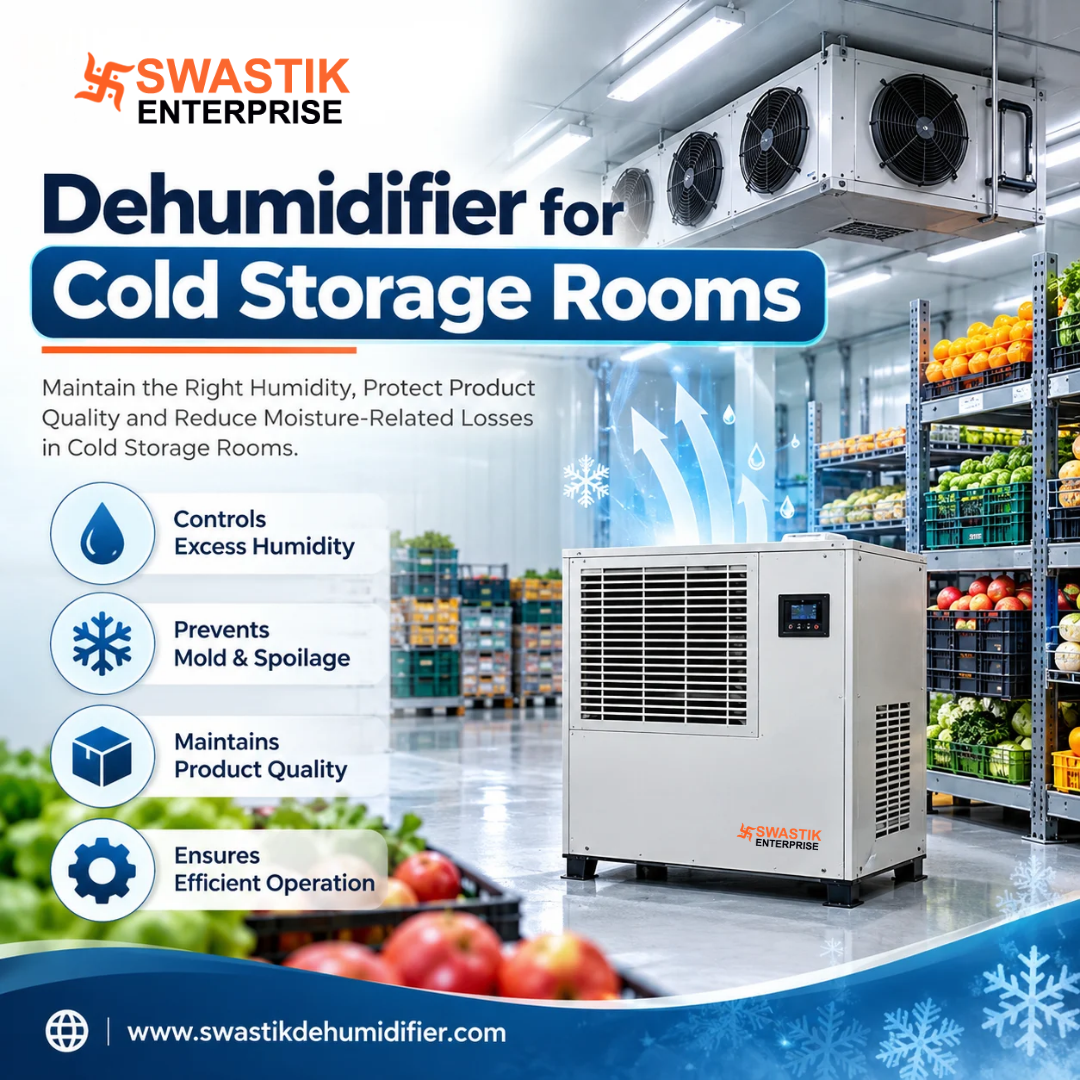
Cold Storage Dehumidifier
Humidity control is essential in ensuring that the best environment is maintained in the refrigerated storage areas. Moisture problems do not necessarily mean that the problem will be solved with the use of lower temperatures. The formation of condensation, frost, ice, corrosion, packaging issues, and others could all arise from moisture. Dehumidification will provide an excellent environment for temperature sensitive goods.
A dehumidifier for cold storage rooms helps remove excess moisture from the air and maintain the required relative humidity. This can be particularly useful in food storage, dairy, pharmaceutical, horticulture and other temperature-controlled facilities where moisture control is important.
In this guide, we explain how cold storage dehumidifiers works, their benefits, suitable types, key selection factors and how proper humidity control can support efficient cold-storage operations.
Why is Humidity Control Important in Cold Storage Rooms?
Although refrigerated spaces are usually kept cool, moisture can get into the space through a variety of sources, including people, objects, doorways, and other things. Condensation happens whenever cool surfaces come into contact with moist air. The moisture can freeze and contribute to frost formation or even ice formation, depending on how moist and cool the air is. There are several issues associated with moisture that may be resolved by managing the humidity levels in cold storage areas, including:
- Condensation: When humid air comes into contact with cold surfaces, moisture can build up on walls, ceilings, floors, doors, and equipment.
- Frost and ice formation: Doors, flooring, evaporators, and other components may be impacted by water vapor freezing on cold surfaces.
- Moisture on surfaces: Undesirable conditions for cold-room equipment and structures can be created by persistent moisture.
- Packaging concerns: Excess moisture in the air will have an effect on some labels, packaging materials, and stored products based on what they are.
- Corrosion: Prolonged exposure to moisture may result in the corrosion of equipment or metals susceptible to it.
- Product quality factors: Controlling the climate is important because all products have varying requirements for storage.
- Infiltration of moisture from door openings: Each time the door is opened, there is a possibility that the air inside will get moist. This will depend on how frequently it occurs.
- Maintaining controlled storage conditions: The environmental conditions needed for specific storage applications can be supported by maintaining the specified temperature and humidity range.
How Does a Dehumidifier Work in a Cold Storage Room?
In order to keep the storage environment within the necessary humidity range, a cold room dehumidifier is made to remove moisture from the air. The type of system chosen determines the exact working principle.
Usually, the dehumidifier is filled with humid air. The system uses a suitable dehumidification technique to remove moisture from this air. After that, the drier air is put back into the storage area.
The operating conditions must be carefully taken into account for low-temperature applications. A system that would normally work for a standard indoor situation may not be suitable in the case of a cold storage requirement. The effectiveness of dehumidification will be affected by the temperature range, dew point, moisture load, and air flow.
Why Low-Temperature Dehumidification Requires the Right Technology?
Dehumidifying a cold storage room can be more challenging than controlling humidity in a normal-temperature environment. At low temperatures, moisture can condense or freeze on surfaces, doors, coils and stored products, potentially affecting storage conditions and equipment performance.
The dehumidifier therefore needs to operate effectively under the actual temperature and humidity conditions of the cold room. A system designed for warmer environments may not provide the required moisture removal at low temperatures.
Desiccant dehumidifiers are often considered for low-temperature applications because they remove moisture by adsorption rather than relying only on cooling the air below its dew point. This makes them suitable for applications where low humidity needs to be maintained even when the room temperature is already low.
Which Type of Dehumidifier Is Suitable for Cold Storage?
The suitable dehumidifier for a cold storage room depends on the operating temperature, required relative humidity, target dew point, room size and moisture load. Both desiccant and refrigerant technologies have different operating characteristics, so the system should be selected according to the specific storage conditions.
Desiccant Dehumidifier for Cold Storage
Desiccant dehumidifiers are often considered for low-temperature applications where conventional moisture removal can become less effective. They remove water vapour through adsorption, allowing moisture to be controlled even when the air temperature is low.
They can be useful for cold storage warehouses and facilities where a low humidity level is required to protect sensitive products, packaging and equipment. Desiccant systems can also be considered where controlling condensation, frost and moisture-related problems is an important part of the storage process.
Refrigerant Dehumidifier
Refrigerant dehumidifiers remove moisture by cooling air below its dew point so that water vapour condenses and can be collected. They can be suitable for applications where the operating temperature allows effective condensation-based dehumidification.
For cold storage applications, however, the actual room temperature and required dew point should be evaluated carefully. As temperature decreases, the available moisture in the air also changes, and system performance can be affected by conditions such as coil temperature and freezing. Therefore, refrigerant dehumidifiers should be selected based on the actual operating conditions rather than simply the room size.
How to Choose Between Refrigerant and Desiccant Dehumidifiers?
| Factor | Refrigerant Dehumidifier | Desiccant Dehumidifier |
| Operating temperature | Depends on system design | Suitable for low-temperature applications |
| Low RH requirement | Application-dependent | Often suitable for lower RH requirements |
| Moisture removal method | Condensation | Adsorption |
| Cold storage suitability | Depends on temperature/application | Often suitable for low-temperature cold rooms |
| Selection | Based on room conditions | Based on room conditions and required RH |
Applications of Dehumidifiers in Cold Storage
Dehumidifiers can be used in different cold-storage environments where excess moisture, condensation or frost may affect stored products, packaging or equipment. The required dehumidification system depends on the storage temperature, product requirements and desired humidity level.
Frozen Food Storage
Frozen food facilities may experience moisture ingress when doors are opened or warm air enters the storage area. Dehumidification can help control excess moisture and reduce condensation and frost-related issues.
Dairy and Ice Cream Cold Rooms
Dairy products and ice cream require controlled storage conditions. Managing humidity can help reduce condensation and moisture accumulation on surfaces, doors and equipment within cold rooms.
Fruit and Vegetable Storage
Fresh produce requires carefully controlled storage conditions to maintain quality and shelf life. Dehumidification can help manage excess moisture where high humidity contributes to condensation or storage-related problems.
Pharmaceutical Cold Storage
Pharmaceutical and healthcare products may require tightly controlled environmental conditions. Dehumidification can help maintain the required humidity range and reduce moisture-related risks in temperature-controlled storage areas.
Flower and Floriculture Storage
Flowers and other floriculture products are sensitive to storage conditions. Proper humidity management can help support suitable environmental conditions and reduce excessive condensation within cold rooms.
Cold Storage Warehouses
Large cold storage warehouses can experience moisture ingress through frequent door openings, loading activities and movement of goods. A suitable dehumidification system can help maintain more stable humidity conditions across the storage area.
Distribution and Logistics Facilities
Cold-chain distribution centres and logistics facilities often have frequent movement between different temperature-controlled zones. Dehumidification can help manage moisture entering through doors and loading areas and support more controlled warehouse conditions.
Benefits of Using a Dehumidifier in Cold Storage Rooms
The following are some advantages that come from having a well-chosen dehumidifier for cold storage:
- Improved humidity control: This is effective for maintaining the desired levels of humidity in an application.
- Decreased condensation: Condensation is minimized in cold surfaces through the reduction of moisture content.
- Controls frost and moisture: Through dehumidification, the water vapor in an application can be minimized to help prevent frost formation.
- Supports product storage conditions: Controlled humidity can complement temperature control where products have defined humidity requirements.
- Helps protect cold-room surfaces and equipment: Reducing excess moisture can help manage moisture exposure around suitable surfaces and equipment.
The type of products being stored, operating settings, system capacity, and room conditions all affect the real benefits.
How to Select a Dehumidifier for Cold Storage?
There is more to choosing a dehumidifier for cold room applications than just taking the size of the space into account. Before defining the system, the following elements should be evaluated.
Cold Storage Room Temperature
One of the most crucial choosing criteria is the operating temperature. A dehumidifier needs to be designed to function well in the cold storage room’s temperature range.
Required Relative Humidity
Based on the items, procedures, and storage needs, establish the desired relative humidity. The chosen system must be able to attain the necessary humidity levels.
Room Volume
The volume of the room and its proportions affect how much air needs to be treated. Greater dehumidification capability or suitable air distribution may be necessary in larger areas.
Moisture Load
Infiltration, door openings, goods, people, air exchange, and other sources can all contribute to the moisture load. Determining the necessary system capacity is made easier by estimating the overall moisture load.
Door Opening Frequency
Humid air may enter a cold room if the doors are opened frequently. Therefore, the dehumidification needs of a space that is closed for long periods of time may differ from those of a cold storage facility with significant traffic.
Product Load and Moisture Generation
Depending on their condition, packing, and temperature, products that enter the room may generate moisture. When choosing a system, the type and amount of products should be taken into account.
Required Dew Point
When controlling condensation and frost, dew point is a crucial factor. The target humidity and room temperature should be assessed in addition to the necessary dew point.
Airflow and Air Distribution
The storage room should have adequate airflow due to the system. Even when the dehumidifier has enough capacity, uneven humidity conditions can arise from poor air distribution.
Dehumidifier Capacity
The computed moisture load and operating conditions should be matched with capacity. Performance and energy consumption can be impacted by oversizing or undersizing the system without taking the actual application into account.
Installation Location
Planning should take into account the link between the dehumidifier and cold room, maintenance access, airflow needs, and available installation space.
Energy Consumption
Another significant aspect to consider when using an industrial dehumidifier for cold storage is the energy consumption. The operating conditions and control methods of the dehumidifier could impact energy consumption.
Cold Storage Dehumidifier Capacity Calculation
Choosing the correct dehumidifier capacity for a cold storage room requires more than calculating the room’s volume. The system should be sized according to the actual moisture load and operating conditions so that it can consistently achieve the required humidity level.
Key factors considered during cold storage dehumidifier sizing include:
Room Volume
The length, width and height of the cold room determine the total air volume that needs to be treated. Larger rooms generally require greater air-handling and moisture-removal capacity.
Temperature
Operating temperature affects the amount of moisture present in the air and the performance of the selected dehumidification technology. The design temperature should therefore be considered when selecting the system.
Initial and Target RH
The existing relative humidity (RH) and the required target RH determine how much moisture needs to be removed. A greater reduction in humidity can require higher dehumidification capacity.
Air Changes
The number of air changes per hour affects the amount of air entering and leaving the room. More frequent air exchange can increase the moisture load.
Door Openings
Regular opening of cold-room doors allows warmer and more humid outside air to enter. Door-opening frequency, duration and size should be considered during capacity calculation.
Product Moisture Load
Products entering the cold room may introduce additional moisture. The type of product, temperature at entry and quantity being stored can significantly affect the total moisture load.
People and Material Movement
Workers, forklifts and material movement can introduce warm, humid air into the storage area. The frequency and duration of these activities should be included in the design assessment.
Outdoor Air Infiltration
Moisture can enter through gaps, doors, loading areas and other points of air leakage. Local outdoor temperature and humidity conditions should be considered when estimating infiltration loads.
For an accurate cold storage dehumidifier capacity calculation, these factors should be evaluated together with the required dew point, operating schedule and desired humidity level. A properly sized system can provide more consistent humidity control and avoid unnecessary energy consumption or inadequate moisture removal.
Why Choose Swastik Dehumidifier for Cold Storage?
Selecting a dehumidifier for cold storage requires consideration of operating temperature, humidity requirements, moisture load and the conditions of the stored products. Swastik Dehumidifier provides industrial humidity-control solutions and has experience in applications where controlled humidity is important.
Industrial Dehumidifier Manufacturing Experience
Swastik Enterprise has been manufacturing dehumidifiers and humidity-control equipment since 1996. Its Ahmedabad-based manufacturing facility supports production, quality control, warehousing and other operational activities.
Ahmedabad Manufacturing Base
Swastik operates from its manufacturing facility in Vatva, Ahmedabad, Gujarat. Its infrastructure is organised across areas including procurement, production, quality control and warehousing to support its manufacturing operations.
Desiccant Dehumidification Solutions
Swastik offers desiccant dehumidifiers for applications requiring moisture control at low temperatures. The company specifically identifies cold storage units, warehouses and logistics hubs among the applications for its desiccant dehumidification systems.
Application-Specific Solutions
Cold storage environments can differ significantly in temperature, humidity, room size, door openings and moisture load. Swastik states that its industrial dehumidifiers are designed according to different operating requirements, allowing the solution to be considered according to the specific application.
Customisation
Swastik provides customised solutions based on application requirements. This can be useful for cold-storage projects where the required humidity level, operating temperature, room configuration and moisture load differ from one facility to another.
Installation and Support
For industrial dehumidification projects, proper installation and technical support are important for achieving the intended humidity-control performance. Swastik states that its services include installation and after-sales support for its dehumidification solutions.
Industrial and Cold-Storage Applications
Swastik’s dehumidification solutions are used across industrial cold storage applications including food processing, pharmaceutical facilities, warehouses and cold storage. Its cold-storage solutions also cover applications such as food processing, dairy and ice cream, floriculture, pharmaceuticals and warehouses.
Frequently Asked Questions About Cold Storage Dehumidifiers
Q1. What is the need for dehumidifiers in a refrigerated room?
The additional moisture in the room through the goods, air entry, door openings, and others can be handled by the use of a dehumidifier. Under certain operating conditions, managing the moisture level can help reduce the effects of moisture.
Q2. Does a dehumidifier work at low temperatures?
Some types of dehumidification equipment are designed specifically to be used at low temperatures. It is essential, however, to check the operating temperature range of the equipment as well as other parameters of its application.
Q3. What is the proper dehumidifier for cold storage?
Some factors that will determine what the proper system to use is include room temperature, humidity requirements, size, moisture load, dew point requirements, and how frequently the doors will be opened. Systems used at low temperatures may require special equipment.
Q4. Can a desiccant dehumidifier be used in cold rooms?
The desiccant systems can work at low temperatures and low dew points, a desiccant dehumidifier may prove appropriate in some cases for cold rooms. The right humidity level, moisture loading, and conditions under which it is to be operated should be considered.
Q5. How can I manage humidity in a refrigeration room?
With the help of moisture source detection, stopping unnecessary entry of air, managing door opening frequency, and using an appropriate dehumidification equipment, humidity management becomes easier. According to storage requirements, temperature, relative humidity, and dew point need to be maintained.
Q6. How do I calculate the required dehumidifier capacity?
Cold storage dehumidifier capacity depends on more than room size. The calculation should consider room volume, operating temperature, initial and target relative humidity, air changes, door-opening frequency, outdoor air infiltration, product moisture load and people or material movement. The required moisture-removal capacity should be calculated from the combined moisture load and the desired operating conditions. For an accurate selection, these parameters should be evaluated by a qualified dehumidification specialist.
Need a Dehumidifier for Your Cold Storage Room?
Do you plan to control humidity in your warehouse or cold storage facility? Tell us the size of your area, its operating temperature, the level of humidity needed, how frequently the doors will open, and more information about your requirements. We can help you choose the right dehumidifier for cold storage rooms.